
Do you enjoy our content?
- A foundation drain is not designed to handle the volume from a roof during a heavy rainstorm
- Roof rainwater clogs the drain with sand and debris, quickly obstructing it despite geotextile usage
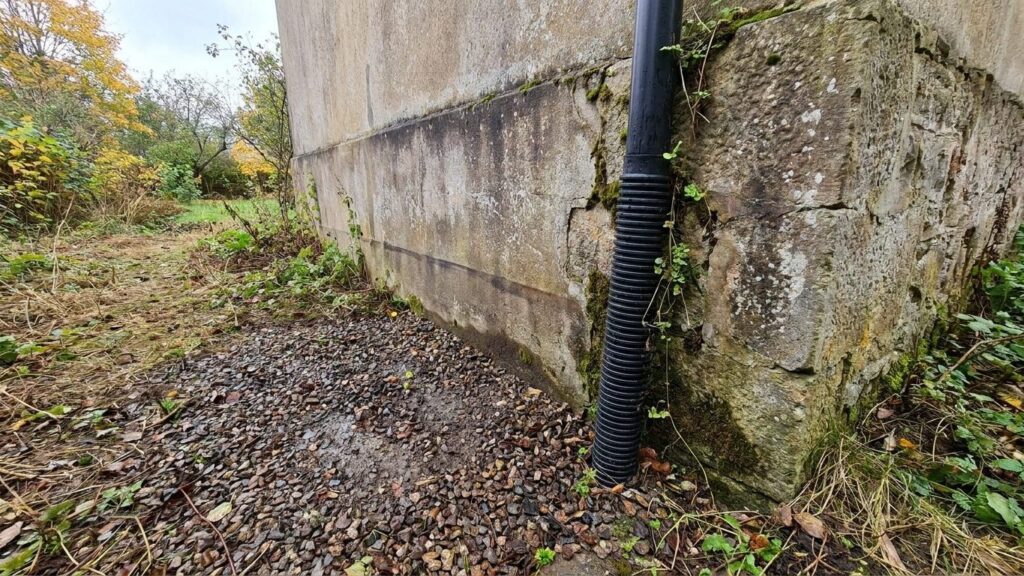
- A consistent moisture line at the base of the wall, four winters later, indicates backup, not just heavy rainfall
The black pipe at the base of the wall, four winters before it cracks
On an October Sunday, he connected his downspout to the pipe left by the mason. The task took ten minutes, involving a PVC elbow and some silicone. Four winters later, it wasn’t the gutter that failed.
This black corrugated pipe, standing vertically against the foundation, rarely catches anyone’s attention. It blends into the landscape, much like the hedges or the garden gate.
No one has revisited that connection since that Sunday.
This detail changes everything: the pipe is not merely an extension of the gutter installed for convenience. It serves a distinct purpose, entirely separate from roof drainage.
What this pipe is supposed to do
A peripheral drain captures groundwater before it reaches the foundation, preventing pressure from building up at the base of the wall. It then directs this water away via gravity to a distant discharge point. It’s a subsurface structure, not a roof drainage outlet.
The reference document for this type of installation is Annex A of the DTU 20.1, which focuses on masonry works with small elements and specifically addresses the design of drainage systems associated with buried masonry. Notably, the use of a standard agricultural drain is prohibited since it was never intended for foundation protection. The standardized pipe must be perforated only on the upper part, as mandated by the DTU 20.1, allowing water to seep in without the bottom getting clogged with mud. A pipe installed simply because “that’s how it’s always worked” does not necessarily adhere to this logic.
A roof is not the same as soil.
The distinction lies in the speed and volume of water flow. A hundred-square-meter roof can discharge, in minutes, what soil releases drop by drop over hours. This difference in timing is precisely what the mason’s pipe was never calibrated to handle.
The Sunday task, repeated every autumn
Every year, around this time, the ritual returns: clearing the downspout of fallen leaves, checking that water drains “away.” It’s a maintenance task, almost an instinctual act of a responsible homeowner.
This rests on a fundamental principle: water flows down, so it moves away. However, the function of a drain is that water takes the path of least resistance, and this controlled passage primarily aims to prevent stagnation at the base of the house, not to absorb a concentrated roof flow within minutes.
The low point is often the house itself.
When the drain is saturated or clogged, water does not magically disappear into the garden. Instead, it remains in contact with the lower parts of the building, with the buried walls bearing the brunt, especially if the discharge is poorly oriented or the ground remains soaked after each rain. The true victim here is not merely a vague sensation of dampness; it’s the wall’s base, the hidden structure that often goes unnoticed.
What the regulatory framework states
DTU 20.1 governs the design of foundation drains. Conversely, the drainage of roof rainwater falls under a different regulation and logic of sizing, with the two systems not substituting for one another.
The relevant authority can actually refuse the connection of rainwater to its own sewage networks, and the Public Health Code allows it to set specific requirements regarding this connection. It even has police powers to limit or prohibit certain discharges through municipal orders.
Fundamentally, no regulation obliges a property owner to connect to a public network for rainwater disposal, unless local regulations dictate otherwise. Each municipal sanitation regulation establishes its own rules, which can vary widely from one city to another.
Some municipalities go further. The local urban plan and stormwater zoning may require specific infiltration devices or precise outflow rates to be respected on the property, meaning that a simple DIY fix could unintentionally deviate from a written rule established at the city hall. The local regulation remains the only document that definitively addresses the issue on a case-by-case basis.






