Do you enjoy our content?
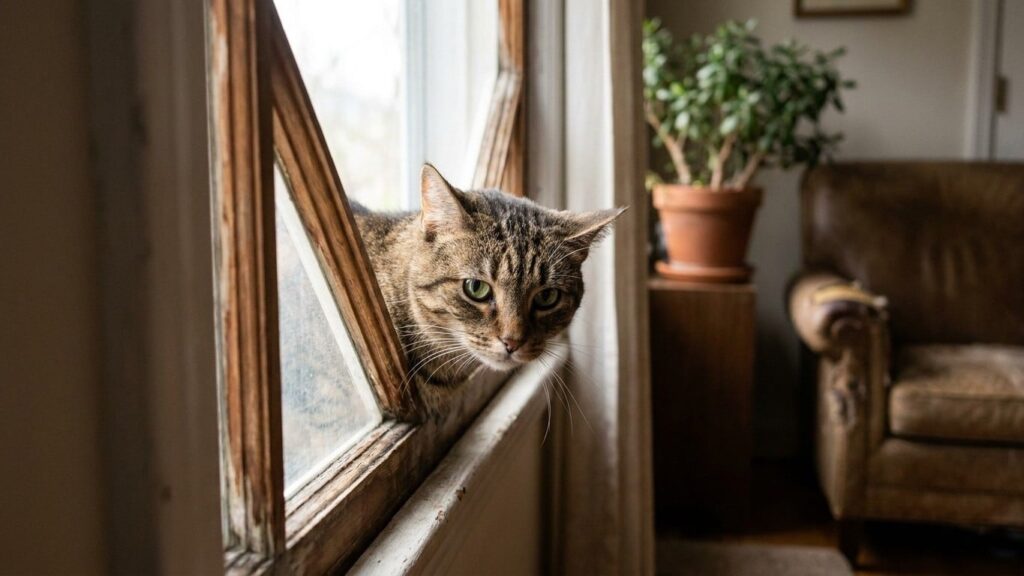
A curious cat, a tilt-and-turn window ajar, and it can take just seconds for the situation to take a turn for the worse. If a cat miscalculates its leap, its body can become trapped in the V-shaped angle created by the window’s opening, precariously straddling the glass. This July, as temperatures rise, thousands of homeowners are leaving their windows tilted open to let in fresh air, often without a second thought. The problem is that this seemingly innocuous gesture can turn a window into a deadly trap for any passing feline.
Key Points
- Why does the V angle of a tilt-and-turn window become such a treacherous trap for cats?
- What internal injuries can a cat sustain in just a matter of minutes?
- Are there really solutions to ventilate without compromising window safety all summer long?
The mechanics of a self-closing trap
A tilt-and-turn window opens from the top along a horizontal axis. It tilts slightly, minimizing the risk of intrusion while allowing for air circulation without creating strong drafts. However, for a cat, the space that forms appears to be an invitation to venture outside. The feline often dives headfirst into the opening, lured by a scent, a bird, or simply the urge to escape. It’s not uncommon for cats to find themselves trapped, their bodies wedged in the window, and as they struggle to free themselves, their movements only exacerbate their entrapment in the angle.
This is where the trap becomes insidious: the more the animal panics, the deeper it becomes ensnared. If the cat tries to find support with its hind legs, it is unlikely to succeed, as its claws will slip on the surface. With each movement, its body becomes increasingly wedged, the abdomen caught tighter in this makeshift vise. There’s no way to maneuver, no chance to retreat. The cat finds itself imprisoned by a mechanism it inadvertently triggered while trying to escape.
Injuries that depend on where the cat gets stuck
The severity of the injury varies based on the part of the body trapped in the vise, and none of the scenarios are reassuring. If the cat is stuck at the abdomen, its organs can become compressed, hindering normal blood circulation, which can lead to tissue necrosis. The crushing force can also rupture blood vessels, causing internal bleeding. If the thorax is affected, the rib cage can be compressed, preventing the lungs from inflating: the animal can literally suffocate, trapped in its own window.
The neck is also at risk. If a cat slips and becomes wedged at the neck, it faces the dangers of suffocation and potential spinal fractures. Veterinarians frequently report cases of cats trapped in a tilt-and-turn window who, in their panicked attempts to escape, ended up with broken backs. A compression lasting just a few minutes can lead to irreversible damage or even be fatal within hours if no one notices. It’s no coincidence that veterinary clinics see a marked uptick in incidents as the thermometer rises: emergency vet services observe a general increase in window-related accidents during the hot season, especially on busy summer weekends.
Securing without sacrificing summer freshness
The good news is that there’s no need to seal off windows for the entire summer. Simple and cost-effective solutions are available. The most common approach is to fill in the V angle itself. There are protective devices designed to facilitate a cat’s passage—a small horizontal platform that fits into the V angle of the window, allowing the animal to find support, which can be installed on either side. Other homeowners prefer to block access entirely: grilles can be affixed to the sides of the window to prevent cats from escaping while still allowing for ventilation without risk, usually sold in pairs.
For renters who cannot drill into PVC, there are alternatives that require no drilling. One cat owner shared that they purchased mesh screens that attach to the sides with double-sided adhesive pads, as they were unable to drill into rental windows. Another, more radical but effective option, is to abandon the tilt position altogether. Investing in a fan or portable air conditioner for heatwave days is another viable solution. Some cat owners also opt for distraction: placing a cat tree near a secured window allows the feline to observe nature and enjoy the scents without the risk of falling or encountering an accident.
Proper actions if the cat is already trapped
Despite all precautions, accidents can still occur, whether at a neighbor’s home or during a visit. In such cases, panic should not dictate your actions. It’s essential to gently slide the cat upward to release it, avoiding any sudden pulls that could worsen potential internal injuries. Afterward, monitoring becomes crucial: if the cat hasn’t been stuck for long and shows no visible injuries or distress, keep it under observation for a few hours to check for any abnormal behavior, breathing difficulties, refusal to eat, or issues with elimination. Consult a veterinarian at the slightest doubt or in the presence of apparent suffering.
One important detail can dramatically alter how we manage such emergencies: even a cat that seems to have regained its composure within minutes may still