
Do you enjoy our content?
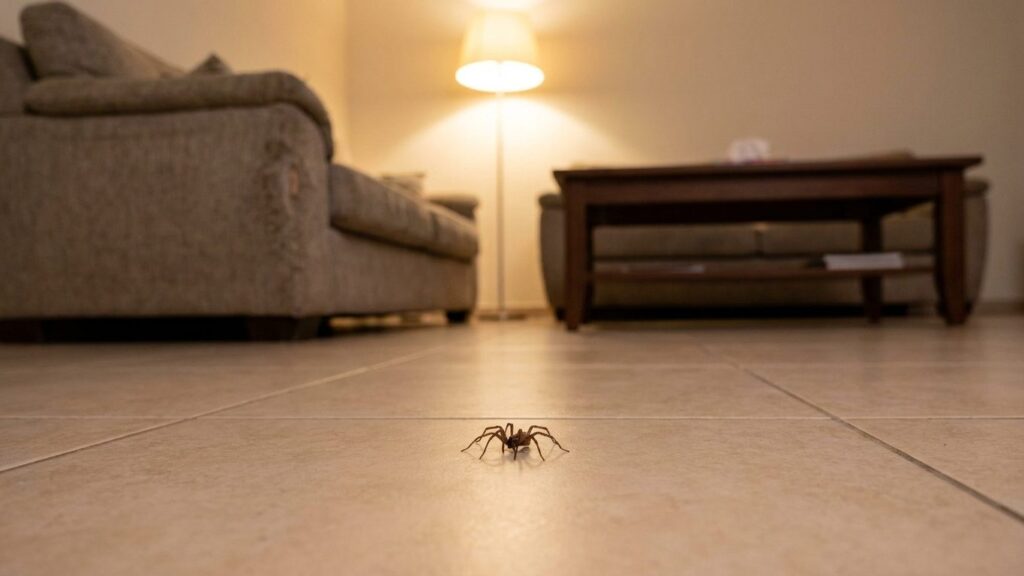
This Monday and Tuesday, the air remains mild, almost summery. However, in thousands of homes, a spider scurries across the living room floor at nightfall. The popular belief perpetuates the same explanation: the cold is approaching, prompting these creatures to seek refuge indoors. This explanation, however, is flawed.
- Male spiders reach sexual maturity in September and actively wander to find females.
- House spiders have never left your home: they have been living there discreetly all year.
- Activity peaks between 8 PM and 11 PM, drawn to light and sustained by flying insects indoors.
- Spiders are cold-blooded animals that do not require warmth to survive.
The persistent but false rumor of cold
Males leave their webs in search of females, which often leads them to explore new territories, including our homes. It is love, not cold, that drives their entry.
The weather has nothing to do with it.
On Wednesday the 16th, the thermometer is set to drop suddenly by 7 degrees. Autumn is arriving abruptly, bringing wind and rain, with the first real chill expected around the 23rd. Coincidentally, it is during these transitional weeks that the phenomenon is most visible, but the drop in temperature is not the cause.
What sexual maturity triggers
Every year, around this time, some males reach sexual maturity after several months of quiet growth. They then leave the stillness of their webs and begin to wander throughout the house, solely in search of a receptive female to mate with before the season ends. This behavior is consistent year after year.
The results are most apparent in the evenings. Their activity peaks between 8 PM and 11 PM, as they are attracted to the light of lamps and televisions. A male can traverse several meters in a single night, crossing a hallway or living room without pause. Focused on their quest, they generally pay little attention to the humans they encounter.
The concept of thermal refuge does not hold up against the biology of the creature. Spiders are cold-blooded animals that regulate their temperature according to their environment; therefore, they have no need for warmth to survive during autumn.
Why sealing windows changes almost nothing
Sealing cracks and placing weatherstripping under doors seems logical. However, most spiders encountered in the fall do not come from the garden; many have lived quietly in the home all year. September is simply when they become more visible.
Almost all of them have never set a foot outside.
A home is often colonized long before autumn, via eggs transported on furniture or construction materials. Sealing an outdoor access point has no effect on a male already living between the walls. The real solution lies elsewhere: reducing what attracts them indoors rather than what allows them to enter.
What truly nourishes them in your home
Homes harbor an abundance of food for spiders: insects drawn by the light or warmth of our interiors provide an easy source. Gnats, moths, small flying insects, this array attracted by nighttime lighting forms the true pantry within our homes.
The more insects a house harbors, the more it attracts easy prey.
Additionally, homes provide a stable environment in terms of temperature and humidity, ideal for a spider seeking a mate, with numerous hiding spots to weave a discreet web under furniture, in dark corners, or behind curtains. Constant heating, the darkness of closets, and the absence of predators have a greater impact on their presence than any cold snap.
A phenomenon that resolves itself
The wandering phase lasts only a few weeks. Once the mating season is over, males typically die from exhaustion, and females return to hiding to lay eggs; calmness returns to the household by the end of October.
No intervention accelerates this cycle.
The eggs laid during this period remain sheltered throughout the winter, hatching the following spring. The peak activity observed these days, between September 14 and the end of the month, corresponds to a specific biological window, not a weather signal.
How to remove a spider without harming it
A turned glass and a piece of paper slipped underneath are enough to capture the creature without injury. It can then be transported, glass still pressed against the paper, to a window or door leading outside, before being released near a wall rather than in open space.
No need for gloves or excessive precautions. Spiders do not sting, and they lack a stinger; they can only bite with their chelicerae if handled directly or threatened.






