
Do you enjoy our content?
What if the solution to the scorching summers that devastate our gardens lies within the seed catalogs of our grandparents? As heatwaves become increasingly frequent and modern tomato plants wilt at the slightest gust of hot wind, an ancient variety is making a remarkable comeback among French growers. Its name resonates like a promise: the Merveille des Marchés.
By late summer, cracked, sunburned tomatoes, or worse, empty stalls, tell the same story year after year. Hybrid cultivars, designed for yield and size, struggle to withstand the nearly commonplace spikes of 104°F. In contrast, this forgotten variety, once relegated to seed archives, is set to reclaim its place in gardens by 2026.
Key takeaways
- Modern tomatoes suffer during repeated heatwaves due to shallow root systems.
- The Merveille des Marchés, an ancient variety, is making a strong return among growers in 2026.
- Its deep root system allows it to access water well beyond the dried-out surface layers.
- It offers natural resistance to water stress without the need for special treatments.
- Its cultivation is accessible for amateur gardeners, provided they follow a few agronomic principles.
Why modern tomatoes no longer withstand extreme summers
Varietal selection over the past decades has prioritized specific commercial criteria: consistent size, transportability, pest resistance, and yield per hectare. While these attributes are valuable to the industry, they come at a cost. Hybrid F1 varieties sold at garden centers often develop a dense but shallow root system, confined to the top 8 inches of soil.
This shallow layer is precisely the one that dries out the fastest during heatwaves. As a result, plants wilt, flowers drop, and fruits either crack or develop blossom end rot, a condition exacerbated by calcium deficiency linked to water scarcity. Even with substantial watering, these modern tomatoes struggle when nighttime temperatures fail to drop.
The ancient variety making a comeback in gardens by 2026
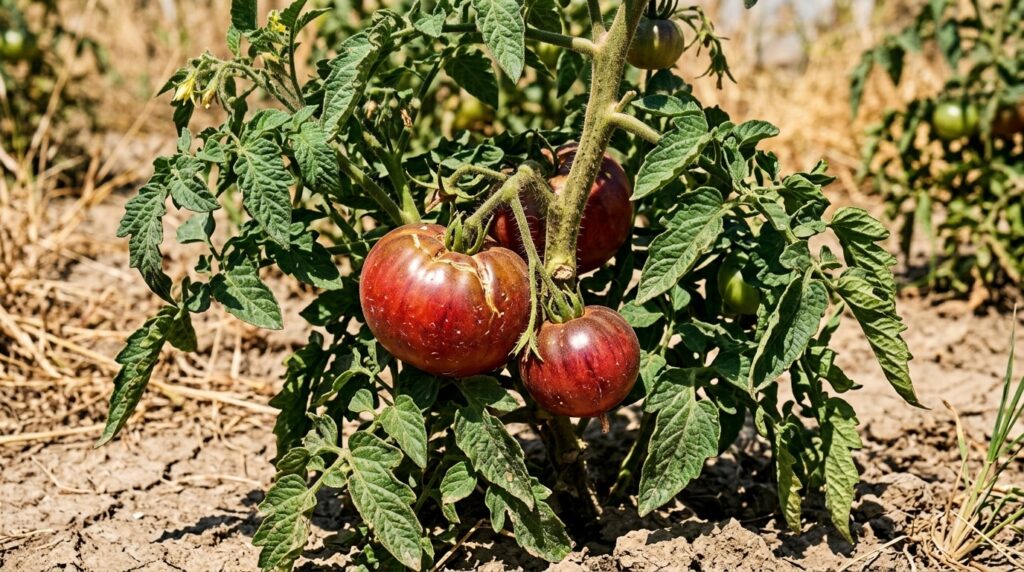
The Merveille des Marchés was once among the most widely cultivated tomatoes in French wholesale markets. Vigorous and indeterminate, it produces round, slightly ribbed fruits known for their dense, flavorful flesh. Its supple skin ensures good holding qualities without succumbing to the blandness often found in industrial varieties.
Long overshadowed by hybrids promising greater productivity, it is reappearing in the catalogs of specialized seed vendors and in the trial beds of organic growers. The reason? Its ability to survive through dry summers without collapsing, where other varieties give up after just two heatwaves. For 2026, several producers are planning significant acreage dedicated to this resilient heirloom.
The secret to its deep rooting system in the face of water stress
The strength of the Merveille des Marchés lies in a precise agronomic trait: it develops a powerful taproot that can reach depths of over 80 centimeters, or even a meter in loose soil. This structure, typical of non-grafted heirloom varieties, allows it to access moisture from deeper layers that remain hydrated even during summer droughts.
Additionally, it features a more refined stomatal regulation: its leaves close their pores earlier in the day, reducing evapotranspiration. The plant may appear slightly droopy at midday, but it regains its vigor by late afternoon without suffering. This water-saving strategy explains why this tomato continues to set and ripen its fruits while others are already scorched.
How to grow it at home for a successful harvest despite the heat
Successful cultivation begins with proper sowing. Start seeds in containers indoors by late winter, around February or March, to have robust young plants ready for transplanting after the Ice Saints. An intermediate repotting, burying the stem deeply, encourages the development of adventitious roots and strengthens the future taproot.
A few key practices make a difference:
- Prepare a planting hole at least 16 inches deep, loosening the soil at the bottom with well-aged compost.
- Space plants 28 to 32 inches apart to allow for air circulation.
- Generously mulch with straw, wood chip mulch, or dry grass clippings to a depth of 3 to 4 inches.
- Water deeply but infrequently, once or twice a week, rather than a little each day.
- Avoid black plastic mulch, which can overheat the soil during peak summer temperatures.
Staking should be sturdy, as this variety is vigorous and produces abundantly. A simple pruning of suckers is sufficient to balance the plant. No special treatments are necessary; the Merveille des Marchés is naturally resistant to the main pests, provided that foliage remains dry.
As summer draws to a close in 2026, gardeners reflect on another season marked by heat, and the return of this heirloom tomato underscores a vital truth: solutions to climate disruption can sometimes be found in the past. Choosing suitable varieties, respecting the soil, and managing watering are the three pillars of a resilient garden. The next step may involve rediscovering other ancient vegetables that can also withstand the summers ahead.
In summary
- Modern hybrid tomatoes struggle with heat due to their shallow rooting systems.
- The Merveille des Marchés, an ancient variety, is reemerging in gardens for 2026.
- Its deep taproot allows it to access water from depths of up to 3 feet.
- It finely regulates its transpiration and naturally resists water stress.
- Early sowing, deep planting, thick mulching, and spaced watering ensure a bountiful harvest.
- This presents a practical pathway to adapt your garden to scorching summers without sacrificing flavor quality.






