
Do you enjoy our content?
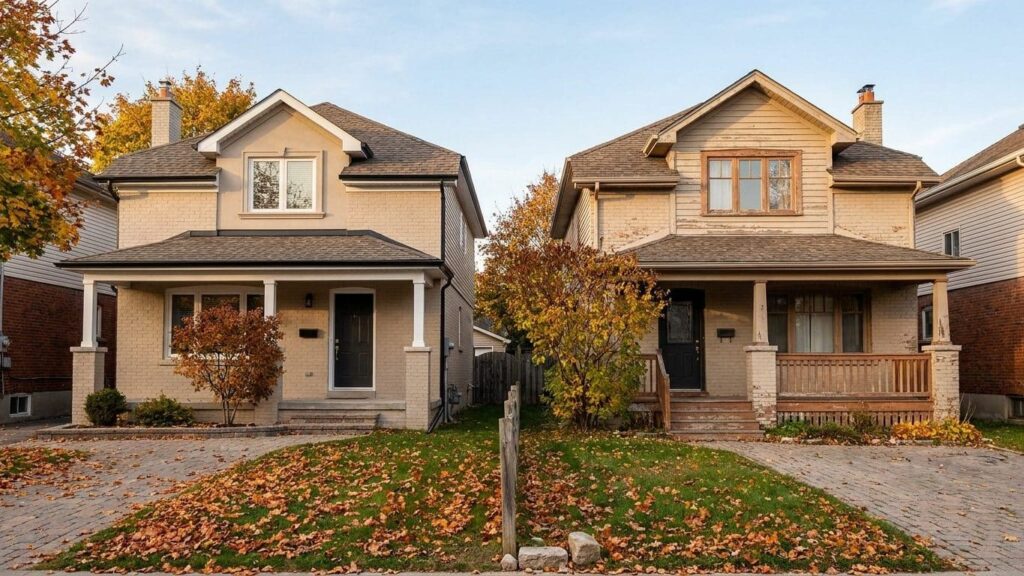
Two neighbors ordered the same beige for their facades at the end of summer: yet only one had to repaint a layer before winter. They chose the same shade, hired the same contractor, and commenced work during the same week. However, one neighbor put down his brushes without ever contacting the city hall, while the other had to wait several weeks for a green light he didn’t know he needed.
The difference lies not in the paint quality or any homeowner association disputes, but rather in an invisible line drawn on a map, which divides two completely different legal frameworks for the same DIY task.
- The vicinity of a historic monument requires prior authorization from the architect of the Buildings of France for any exterior work.
- This protection zone extends up to 500 meters from the monument or according to a perimeter defined on a case-by-case basis by the municipality.
- A simple call to city hall reveals whether a property is located within this zone and what administrative steps are necessary.
One can of paint, two administrative paths
The first neighbor simply contacted his painter, selected his shade from the store’s color chart, and initiated the work on the first dry weekend in September. No formalities, no waiting period.
The second neighbor, however, had to navigate a different process. His home is located within what the heritage code terms the vicinity of a historic monument, a protection zone that activates whenever a building is visible from a classified or registered structure, or within its line of sight.
This protection pertains to buildings, whether constructed or not, that are visible from the historic monument or within the same field of vision, and situated within five hundred meters of the edifice. Five hundred meters is quite a distance, an entire block can fall under this regime without anyone noticing upon moving in.
The vicinity of a historic monument, an invisible boundary
Historically set at 500 meters, this zone has since been replaced by the 2016 law on the freedom of creation, architecture, and heritage, which defines an area of protection on a case-by-case basis, no longer automatically corresponding to a circular boundary. The limit may have been redrawn by the municipality to align with the actual terrain, expanding or contracting depending on the layout of the area.
This zone can be smaller than the 500-meter mark when a monument is situated in an environment too degraded to warrant protection, or conversely, larger if the local geography demands it, as seen with the extended boundaries around the Palace of Versailles. Each municipality potentially has its own tailored map surrounding its protected monuments.
This zoning is not trivial; it determines whether a simple paint job falls under the owner’s free choice or requires adherence to state regulations.
What the law truly requires in this perimeter
Any work that may alter the exterior appearance of a building, whether constructed or not, protected under the vicinity regulations is subject to prior authorization, which requires the agreement of the architect of the Buildings of France. Exterior facade restoration falls squarely within this category, alongside changes to windows or roof renovations.
All exterior work in an ABF zone necessitates at least a preliminary declaration. This is the document the second neighbor needed to submit to city hall before making any changes to his facade, while the first neighbor did not.
Once the application is submitted, the municipality does not process it alone. Upon submission, the municipality automatically sends a copy to the architect of the Buildings of France. This transmission, invisible to the applicant, delayed the project for the affected neighbor.
The scale of this system often surprises. Of the 400,000 opinions rendered annually by the architects of the Buildings of France, over half pertain to the vicinity of historic monuments. This scenario is far from isolated for these two neighbors.
Simple or conforming opinion, a nuance that changes everything
Not all opinions from the ABF are created equal. In some protected areas, the opinion remains advisory, allowing the municipality some discretion.
Depending on the classification of the monument, the ABF’s opinion may either be simple and thus advisory, or conforming, which the municipality must then follow. Typically, in the vicinity of a classified historic monument, the latter applies.
The architect of the Buildings of France can issue an agreement, an agreement with conditions, or a refusal, and the mayor’s order must necessarily reflect this opinion. This is referred to as “competence liée”: the mayor cannot override this, even if they wanted to.
The owner who had to repaint twice was not necessarily denied his color choice; he merely followed an approval process that his neighbor, just a few meters away, never had to navigate.