
Do you enjoy our content?
In the orchards of yesteryear, a subtle ritual marked the end of summer: the whitewashing of tree trunks. This practice intrigues today’s passersby, often seen as a mere aesthetic legacy. However, this chalky coating was far from a farmer’s vanity.
Behind this gesture, passed down through generations, lies a genuine strategy for protecting fruit trees. As summer winds down and harvest approaches, it’s time to rediscover this technique that combines practical wisdom with remarkable effectiveness.
- The whitewash is an ancient practice for protecting fruit trees.
- It is traditionally made from lime.
- Applied at the end of summer, it eliminates pests and fungi residing in the bark.
- It also protects the trunk from winter temperature fluctuations.
- Modern alternatives exist that are gentler yet equally effective.
An ancestral gesture forgotten that protected orchards for centuries
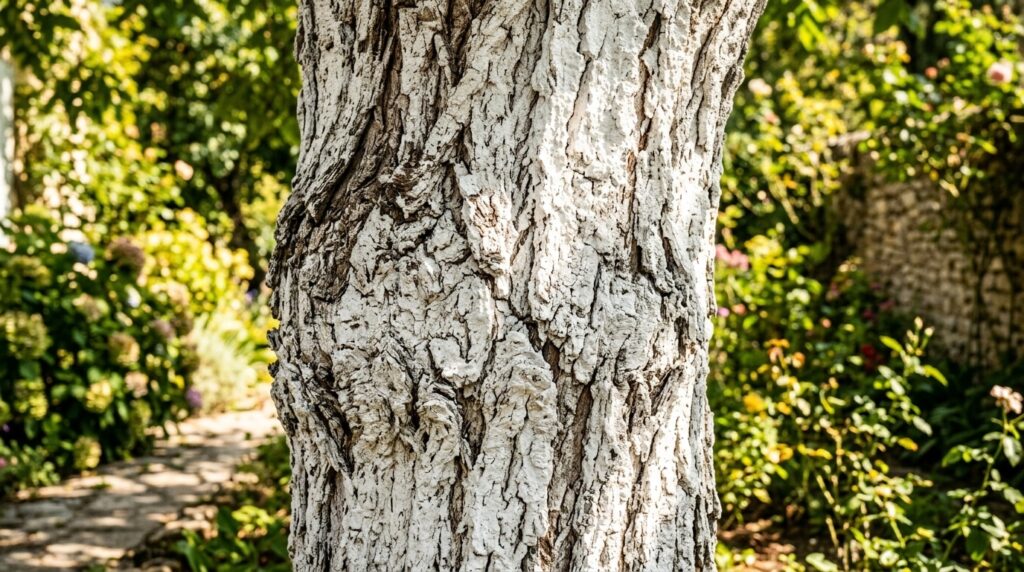
For a long time in the French countryside, the end of summer meant a specific chore: whitening the trunks of apple, pear, cherry, and plum trees. Orchardists, armed with a bucket and a wide brush, applied a lime wash to each trunk up to the first branches. This pristine orchard landscape was a familiar sight from Limousin to Normandy and through the Provençal orchards.
With the widespread adoption of synthetic plant treatments in the 20th century, this practice gradually faded, deemed too simple or rustic. Yet, it has made a strong comeback in recent years, championed by gardeners eager to embrace natural methods and the resurgence of organic horticulture.
What whitewash truly does to a tree’s bark
The action of arboricultural whitewash is more complex than it appears. Once applied to the bark, lime works on multiple levels. Its highly basic pH deeply disinfects, penetrating every crevice of the trunk where pests seek refuge before winter.
Specifically, this whitewash destroys the eggs of harmful insects laid in the bark’s nooks: codling moths, scale insects, woolly aphids, as well as the larvae that hibernate, patiently waiting for spring. It also eliminates spores of pathogenic fungi such as scab, canker, or brown rot, which are responsible for many fruit diseases.
Another significant benefit: the white color reflects sunlight during bright winter days. This prevents drastic temperature fluctuations between a trunk warmed by the sun during the day and frozen at night, fluctuations that lead to those infamous vertical cracks known as frost cracks. The whitewash thus becomes a true thermal shield.
How to prepare and apply arboricultural whitewash at the end of summer
The traditional recipe is simple and economical. It consists of a few easily found ingredients available at garden centers or hardware stores like Botanic, Jardiland, or Leroy Merlin.
- 1 kg of hydrated lime (type CL 90)
- 5 liters of warm water
- 100 g of green clay powder (for consistency)
- 2 tablespoons of linseed oil (for adhesion)
Gradually mix the lime into the water, stirring vigorously to avoid lumps. Next, add the clay and then the linseed oil. The mixture should have the consistency of thick paint, similar to that of stirred yogurt. Caution: lime is corrosive, so wear gloves, goggles, and protective clothing.
Application should be done with a wide brush or roller, on a dry day, on a healthy and dry trunk. Beforehand, brush the bark with a soft metal brush to remove moss and lichens. Then, apply the whitewash from the base of the trunk to the first major branches. Generally, a single coat is sufficient, but two passes will ensure better adherence until spring.
Common mistakes to avoid and modern alternatives for treating trees
The first frequent mistake is to apply the whitewash on a young tree with still thin and smooth bark. This can burn the tissues. Arboricultural whitewash is reserved for trees older than three or four years, with bark that is already cracked. Another pitfall is using a lime mixture that is too concentrated, which can crack and peel off quickly.
It is also essential to avoid applying the product in rainy weather or just before a downpour, as this can wash away all your hard work. An ideal dry period of 48 hours after application is required for optimal adhesion.
For gardeners hesitant about using lime, there are now ready-to-use arboricultural whites sold in garden centers, often made from white clay or kaolin. Less aggressive, they provide interesting protection, albeit slightly less disinfecting. There are also whitewashes enriched with essential oils, such as neem or sage, that enhance the repellent effect against insects.
Reviving this ancient practice offers your fruit trees natural, economical, and remarkably effective protection, perfectly in tune with the cycles of the orchard. Embracing the methods of the past might just be one of the best actions to take this late summer to prepare for a fruitful season next year.
In summary:
- The whitewashing of trunks is an ancient arboricultural tradition with multiple benefits.
- Lime destroys the eggs of pests, larvae, and fungal spores residing in the bark.
- The white color protects the trunk from winter frost by reflecting light.
- Preparation consists of lime, water, clay, and linseed oil.
- Apply at the end of summer, on mature trees, in dry weather, with protective gear.
- Gentler alternatives based on kaolin are available for a softer approach.






