
Do you love our content?
In the height of summer, nature thrives and bustles with activity. Amidst thick hedges and blooming flower beds, our gardens often transform into open-air nurseries. It’s not uncommon during this season to encounter young birds awkwardly attempting their first flights away from their parental nests. Faced with a small ball of feathers hopping on the lawn, the instinct of many nature lovers is to intervene and rescue the creature. However, this urge to act can stem from a fundamental misunderstanding of animal behavior. Should we really interfere with such a delicate natural cycle? The answer to this question requires us to reconsider our instincts in order to genuinely protect the wildlife around us without inadvertently causing more harm.
The well-meaning instinct that can lead to disaster
When confronted with this seemingly clumsy creature, the worst mistake is often to scoop it up immediately, either to take it inside the house or rush it to a rescue center thinking you’re saving it. This natural and compassionate reflex can actually be catastrophic for the animal, which is, in fact, not in danger at all. By acting in this way, we inadvertently remove it from its environment, drastically reducing its chances of survival. Confining it to a cardboard box in the living room causes immense stress and deprives it of the specific nourishment that only its parents can provide. It’s better to resist the urge to play the role of the impromptu veterinarian to avoid committing an irreparable mistake.
Learning to fly sometimes involves a few rough landings
In the vast majority of situations we observe on the lawn during summer vacations, the bird is neither injured nor abandoned. It is simply undergoing a vital and unavoidable stage: the learning-to-fly phase. It is quite common for young birds to leave their nests long before mastering the art of flight. If this little creature is fluttering, hopping, falling, and stumbling through the tall grass, this is a normal part of its emancipation process. Its muscles need to strengthen, and this practice on the ground is absolutely essential. If it has its eyes wide open, stands on its feet, and hops energetically, this little acrobat is just making a few mistakes along the way before achieving its ultimate flight toward independence.
Invisible parents still caring for their young
One should never assume that the chick is alone in facing the dangers of the vast green world. One of the main reasons not to approach is the discreet presence of its family. The parents are usually nearby, hidden in the canopy of a neighboring tree, on the house’s gutter, or in a thick bush. They closely monitor every move of their young one and often wait for curious humans to leave before coming down to feed it. By intervening, we scare away the adults, which halts the distribution of food. Allowing nature to take its course gives the natural educational system the space to unfold quietly.
Featherlessness is the only real signal of alarm
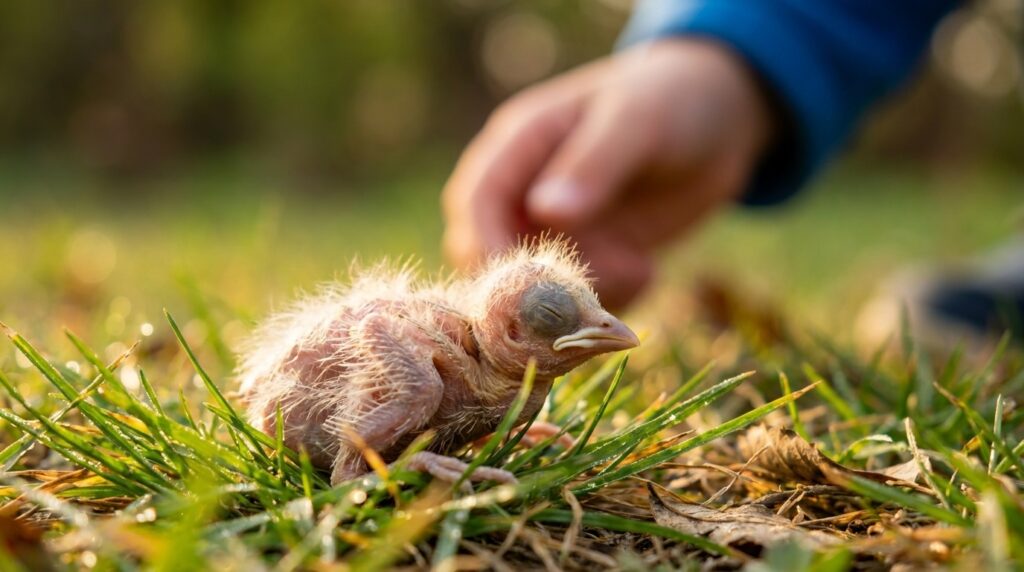
So when is danger truly present? The answer lies in a quick examination of the anatomy: a bare or sparsely feathered bird is in absolute emergency. If it has only a sparse downy covering or is completely bare, it has fallen prematurely from its shelter due to adverse weather, a parasite, or conflict within the brood. This tiny creature cannot regulate its body temperature and is unable to move. In this specific case, and only in this scenario, the abandoned chick risks succumbing to hunger, the sun, or nighttime hypothermia. Vulnerability is total and requires a helping hand to rectify the situation.
The saving gesture: gently returning it to its nest
When it becomes necessary to take action for a completely unprotected chick, the first step is to locate its original point of fall, usually directly above. Contrary to popular belief, birds have an extremely weak sense of smell; thus, there is little risk that the sibling or mother will reject the survivor simply because it has been touched by human hands. You can gently and cautiously place it back in its original spot. If the original nest has been swept away by a summer storm, feel free to construct a new one using a perforated plastic container or a wicker basket lined with dry grass. By securing it high up, shaded by a thick branch, there’s a good chance the adults will come to care for this makeshift abode and continue to raise their young.
Keeping your distance and observing is the best rescue approach
For all those intrepid little fliers clumsily hopping from bush to flower pot, the most powerful and helpful action often comes down to simply doing nothing. One should step back, ideally behind a glass door or at a considerable distance from the scene, to allow the environment to reclaim its natural order. The primary duty then is to neutralize true terrestrial predators; temporarily confining domestic cats or keeping dogs under control while nature takes its course. If the animal is in direct sunlight or on a heavily trafficked concrete path, it is permissible to gently lift it and place it a little further away on a low branch for safety.
Resisting the temptation to play the hero of biodiversity may seem counterintuitive, but it is indeed the most coherent and responsible approach. By learning to differentiate between a normal transitional phase and genuine distress based on the feathering stage, we can become true allies of our local wildlife. The real ecological transition sometimes lies in understanding an ecosystem rather than trying to control it. What if respectful observation of this wildlife in the midst of discovery became our new favorite summer pastime?






