Do you enjoy our content?
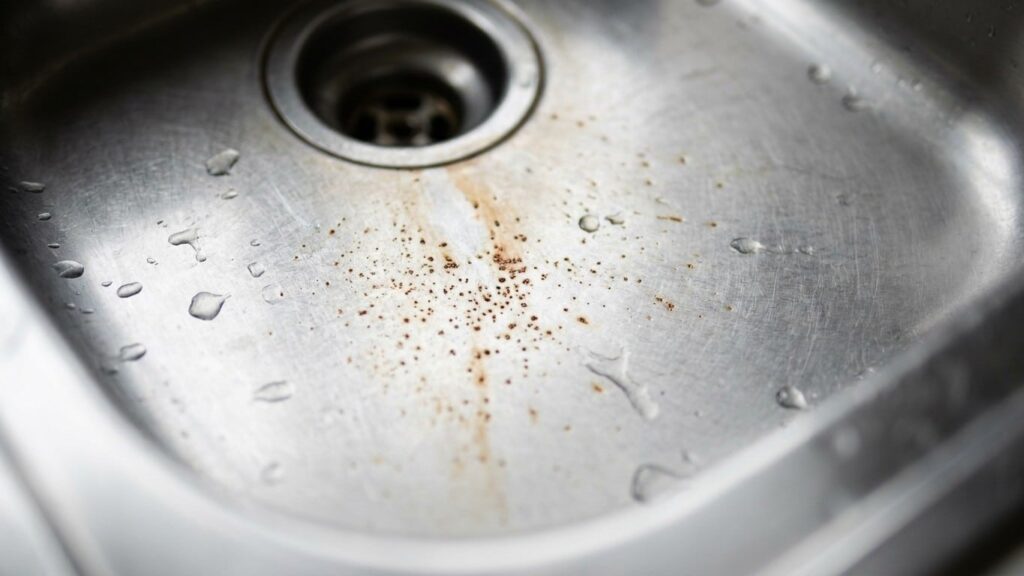
Those tiny brown spots that dot the bottom of your sink, right under the faucet where you consistently pour diluted bleach for disinfection? The chlorine in that product directly attacks the thin layer of chrome protecting the steel, triggering chemical reactions that result in rust spots that can’t be wiped away with a simple sponge. Stainless steel isn’t magic; it certainly doesn’t live up to its name when it comes into contact with bleach.
Key Takeaways
- Your daily cleaning product creates an invisible chemical reaction that perpetuates itself.
- The protective layer of your sink is microscopic and vulnerable to certain chemicals.
- Stains can appear days after cleaning when you least expect them.
The paradox of stainless steel
A stainless steel sink is never completely immune to corrosion. Its resistance relies on a specific physico-chemical phenomenon: stainless steel is primarily composed of iron, carbon, and chrome. The addition of at least 10.5% chrome forms a stable, thin layer of chromium oxide on the surface, acting as a protective barrier against corrosion by preventing the underlying metal from reacting with oxygen and other environmental elements. This film is astonishingly thin; according to an educational document from the Academy of Poitiers, this passive layer consists of just a few atomic layers and can naturally reform in the presence of air or water oxygen.
This is the genius of the material, and it’s also its vulnerability. The protective film spontaneously regenerates after minor scratches, but it cannot withstand everything. An industrial manufacturer summarizes it bluntly: chloride ions found in bleach aggressively penetrate the chromium oxide layer that protects stainless steel from corrosion, disrupting the passive film and leading to localized degradation and corrosion. Your sink doesn’t rust because it is of poor quality; it rusts because it has been subjected to a chemical attack that no domestic stainless steel can fully endure.
How chlorine literally penetrates metal
This mechanism deserves detailed explanation, as it clarifies why stains often appear well after cleaning—sometimes days later. Chlorine ions do not merely “dirty” the surface; they chemically react with the protective chrome. A precise technical analysis indicates that chloride ions play a critical role in the corrosion of stainless steel by destabilizing its protective chromium oxide layer through electrochemical reactions, forming soluble chromium chloride that depletes the chrome in the passive layer, exposing the underlying iron to corrosion.
Once this breach is opened, the process becomes self-perpetuating. Experts in localized corrosion explain that once a small pit forms, it becomes a self-sustaining corrosion site, with the environment inside the pit becoming highly concentrated with metal ions and acids, accelerating the attack even as the rest of the surface remains intact. This is precisely what happens in your sink: a minuscule, initially invisible pit that will grow on its own due to its internal chemistry, even after you’ve rinsed and dried it.
Exposure time is crucial. A study on this subject indicates that short-term exposure, ranging from 4 to 11 days, can lead to visible stains and localized pitting, while prolonged exposure over several weeks can cause structural weakening and rust deposits due to the penetration of chloride ions. A sink used daily and cleaned with bleach once a week accumulates, often unnoticed, chronic exposure sufficient to initiate this phenomenon.
It’s not just about the product, but also habits
Bleach is not the only culprit. Other seemingly harmless actions also weaken the same protective layer and create a breeding ground for rust. Specialized organizations in metal corrosion list several aggravating factors: salt, seawater, and even de-icing products contain chlorides that attack the protective film, while dust, grease, or cleaning residues create small pockets where moisture becomes trapped. A sink that is not thoroughly dried after using bleach thus combines both problems: chemical chlorine and stagnant moisture.
There’s also a common misconception that should not be confused with the phenomenon we are discussing here. A technical brochure points out that contact with non-stainless steel objects, such as knives or steel pads, can leave tiny ferrous particles on the surface that, in a humid environment, oxidize and create the impression that the sink is rusting. This contamination rust is easily cleaned, unlike the pitting caused by chlorine, which embeds itself permanently in the metal.
What to do if stains are already present
The most effective reflex is preventative: completely eliminate pure bleach from your routine maintenance of stainless steel. An article dedicated to the upkeep of commercial sinks summarizes the minimum precautions if you still wish to use it: dilute the solution heavily, never apply it hot, limit contact time to a few minutes, and then rinse thoroughly with clear water and dry immediately with a cloth. A lapse in any of these points is enough to restart the process.
For stains that have already formed, it is better to act gently than aggressively. Scrubbing vigorously with an abrasive sponge or steel wool worsens the situation by creating new micro-scratches that expose even more bare metal. Professional recommendations converge towards using mild, non-abrasive products applied in the direction of the stainless steel grain, followed by careful rinsing. In more severe cases, a treatment known as passivation, using diluted citric or nitric acid,