
Do you enjoy our content?
- A crack less than 0.2 mm only warrants repair without prior assessment.
- A sticking door, uneven floor, or recurring cracks in corners indicate a structural issue.
- The shrink-swell behavior of clay soils during dry summers causes cracks that plaster won’t fix.
- Installing a plaster witness before repair allows you to track the crack’s progression.
One Sunday, a putty knife, a smooth ceiling
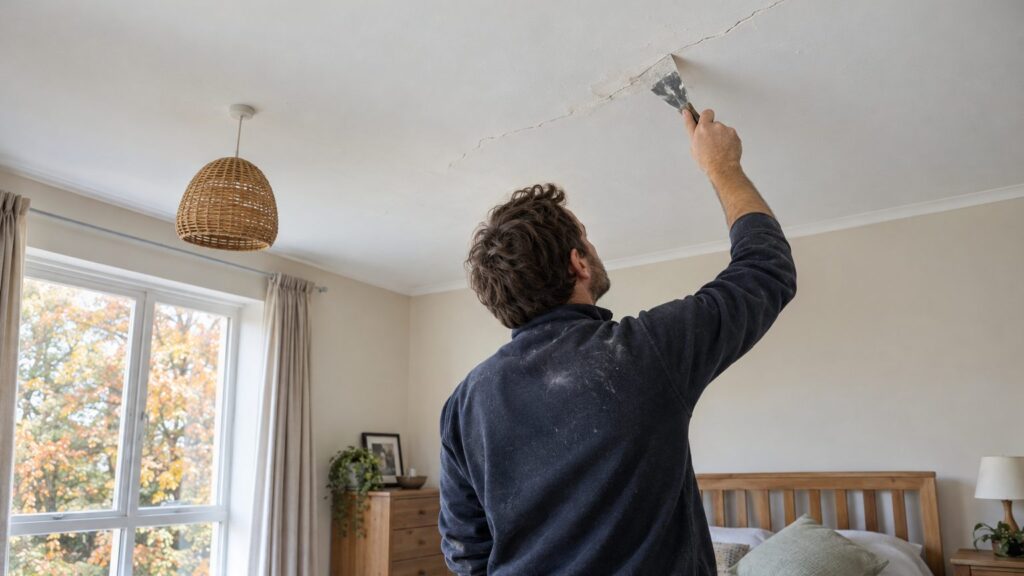
On a Sunday, I repaired the crack in the bedroom ceiling with plaster, and three months later, it was the door that started sticking that taught me I had only addressed the symptom. The crack had been running above the bed since late summer. I took out my putty knife, made two passes, sanded, and repainted.
The ceiling was once again white and uniform.
This DIY project is a classic for the autumn season: there are countless tutorials that promise to erase a crack without major renovations. The method is quick, inexpensive, and accessible to anyone equipped with a bucket and a spatula. It is perfectly suited for a specific case: microcracks, those less than 0.2 mm, which remain superficial and only affect the plaster, according to Qualitel. The real challenge is determining whether your crack falls into this category.
The door’s friction, a sound like sandpaper
One evening, the bedroom door began to scrape as it closed. Nothing dramatic, just a bit of resistance at the end, a sound like sandpaper that I hadn’t noticed before. I attributed it to humidity, like everyone else.
Then I revisited Qualitel’s list of warning signs. Sticking doors are mentioned there, along with uneven floors and recurring cracks in corners. Three indicators, and I was already ticking one off without realizing it.
Perhaps I didn’t have two small issues, but rather one larger one.
I remain cautious: a sticking door alone proves nothing, and Qualitel’s page doesn’t specifically address ceilings. So, I’m discussing an interior crack, without claiming to apply ceiling-specific rules. However, the doubt is there. And doubt can be measured.
What the size and shape of a crack reveal
Qualitel provides simple numerical guidelines. Below 0.2 mm, we’re dealing with a microcrack, superficial and located within the plaster. Beyond 2 mm, the opinion of a professional is necessary to assess the situation. In between, observation takes precedence over DIY fixes.
The shape of the crack also conveys information. A structural crack may be vertical, indicating foundation issues. It can take on a mustache shape at the corners of windows and doors, run horizontally at the floor level, or form a staircase pattern in masonry joints. Four shapes to recognize before reaching for the plaster.
Lastly, a through crack, visible inside and outside, is presented by Qualitel as the concerning signal for structural integrity. I hadn’t taken the time to inspect the other side of the wall. A simple walkthrough of the house, quick and free, could have changed my interpretation of the crack.
A dry summer, clayey soils, cracks upon return
Weekend DIY projects resume every autumn, and so do the cracks. After a dry summer, clay soils contract, a phenomenon that Qualitel classifies as a major cause of cracking under the term shrink-swell of clays. The house rests on this soil, and when it shifts, the house shifts too.
The putty knife offers no insight into the ground beneath the house.
Moreover, a crack that returns in the corners after being repaired is one of the signs Qualitel highlights. By filling in the crack, I had erased my best indicator: its original width, its pattern, and its date of appearance. Qualitel actually recommends not to fill in the crack while waiting for an assessment and instead to place plaster witnesses. I did exactly the opposite, all while enjoying a successful Sunday.