Do you enjoy our content?
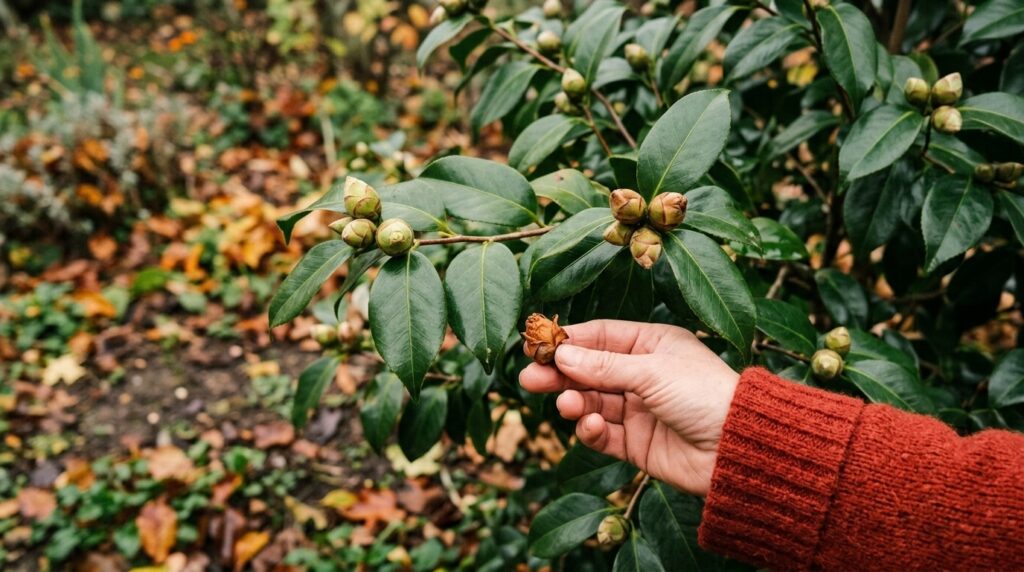
A camellia with glossy green leaves does not always guarantee blooming in the following spring. Beneath this reassuring foliage, a subtle imbalance may already be developing at the root level, threatening the flower buds that have been patiently forming since summer. This often-underestimated risk can lead to a sudden drop of buds before they have a chance to bloom, ruining months of anticipation. Before the first cold weather sets in, one specific point deserves attention at the base of the shrub to avoid this disappointment.
- Check the soil moisture at a depth of 5 cm at the base of the camellia, as dry and crumbly soil can weaken floral buds even if the foliage appears healthy
- Apply a 5 cm layer of pine bark mulch around the base, leaving a clear space near the trunk to prevent fungal diseases
- Water regularly with rainwater (1 to 2 times a week in the absence of rain) until the first frosts, as camellias poorly tolerate the hard water from taps
- Why camellia buds fall before blooming
- The point to check at the base of the shrub before the first cold
- How to install pine bark mulch to protect the roots
- Adjusting watering with rainwater until the first frosts
Why camellia buds fall before blooming
The camellia (Camellia japonica) begins forming its flower buds as early as late summer, anticipating a bloom that will not occur until several months later, often in late winter or early spring depending on the variety and region. This lengthy waiting period makes the buds particularly vulnerable to sudden changes in soil moisture and temperature. Even brief periods of drought can sometimes jeopardize their development.
For example, consider a camellia planted in a partially shaded location, an ideal spot for this plant, which does not thrive in the scorching afternoon sun. After a spell of autumn dryness, the soil can dry out sharply at the surface and then deeper if no rain replenishes it. The camellia’s shallow roots then suffer from water deprivation right when the plant needs stability to secure its buds. The result? The buds turn brown, dry out, and fall off without ever blooming, while the leaves continue to appear healthy for weeks.
The point to check at the base of the shrub before the first cold
Before the nights become noticeably chilly, a simple assessment can help mitigate this risk. Inspect the soil condition directly at the base of the camellia, where the roots draw most of their moisture. This check requires no sophisticated tools or special skills, just a bit of attention to the texture and temperature of the soil.
In practical terms, lightly scratch the surface to a depth of about 5 centimeters using a small garden fork or even your fingers. If the soil feels dry, crumbly, or dusty at that depth, that’s a warning sign. This observation often coincides with another revealing factor: the absence of protective mulch around the root collar, the transition zone between the roots and the trunk base. Without this protective layer, the soil remains exposed to temperature fluctuations and moisture loss, both of which directly compromise the integrity of the floral buds during autumn.
How to install pine bark mulch to protect the roots
Once this assessment is made, the most effective solution is to apply a vegetative mulch that can help regulate both soil moisture and temperature. Pine bark mulch is particularly suitable for camellias, as it aligns with their preference for acidic soils, typical of plants that thrive in heathland. This mulch limits water evaporation, mitigates drastic temperature changes, and contributes, through slow decomposition, to enriching the substrate slightly.
The recommended thickness is around 5 centimeters, spread in a circle around the base of the shrub. However, be sure to leave a small space directly around the trunk to prevent prolonged contact between wet bark and the collar, which could encourage the development of fungal diseases. This simple act, to be repeated if the layer thins over time, creates a genuine protective barrier for the camellia’s shallow roots, especially vulnerable to temperature fluctuations as winter approaches.
Adjusting watering with rainwater until the first frosts
Mulching alone is not always sufficient to compensate for an established drought. Regular watering remains essential until temperatures are consistently below freezing, particularly if the autumn is dry and mild, delaying the plant’s dormancy. The choice of water is crucial here, as camellias do not tolerate the limestone found in tap water in many regions.
Rainwater, collected in a simple barrel placed under a downspout, is the most suitable option for this type of lime-sensitive shrub. Watering once or twice a week in the absence of natural precipitation allows this soft water to maintain consistent moisture levels at the roots without causing thermal shock. The immediate installation of a 5-centimeter layer of pine bark mulch, combined with regular watering using rainwater, forms the most reliable approach to prevent the water and thermal stress responsible for bud drop in October.
These two modest actions can significantly impact a camellia planted in the ground as well as one in a pot on an urban terrace. Nevertheless, vigilance is necessary depending on the regions, as clay soils naturally retain more water than sandy soils, and the mild winters of the Atlantic coast don’t impose the same challenges as the more continental autumns inland. Regular soil checks until the first frosts allow for adjustments in care over the weeks, giving the camellia the best chance to fulfill its promises of blooming when the warm days return.