
Do you enjoy our content?
- Warm air from a radiator significantly loses moisture.
- Solid wood contracts when the air becomes persistently dry.
- Keeping furniture away from heat sources minimizes splitting and warping.
When heated air loses its moisture
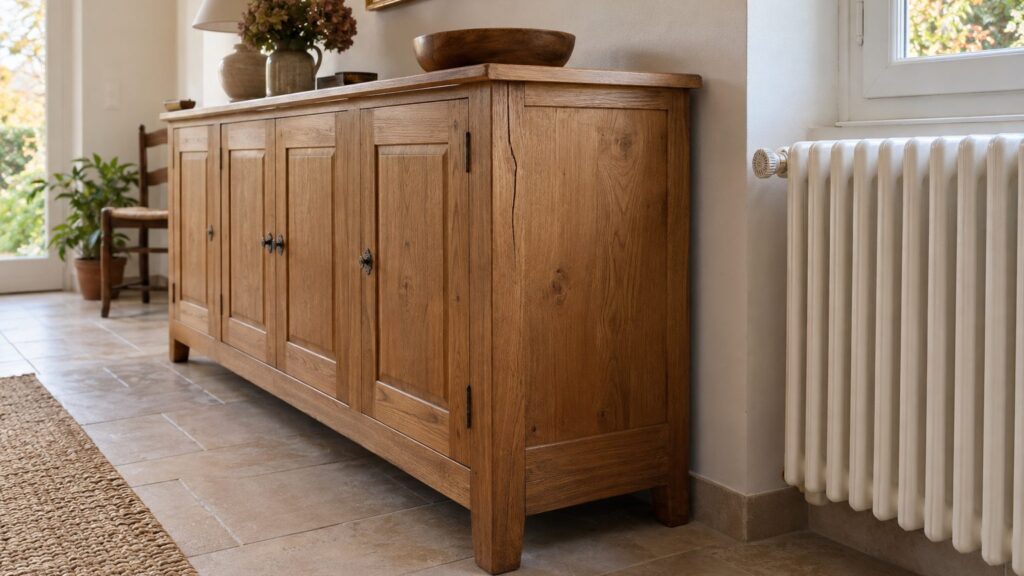
A solid wood sideboard pressed against a radiator endures the driest air in the room each winter. The mechanism is straightforward: heating cold air decreases its relative humidity (RH), leading to the low values observed during the winter months, as highlighted by the Canadian Conservation Institute (CCI) on their page about inadequate relative humidity. While the institute focuses on museum collections, the underlying physical phenomenon applies equally to a living room.
However, wood continues to react to the surrounding air.
A solid wood piece is constructed from planks that have dried but still exchange moisture with the environment. They expand when the air becomes humid and contract when it dries out. These movements usually go unnoticed as long as the joints can accommodate them. When the air remains dry, the contraction accumulates, causing shelves, panels, and doors to be pulled in various directions.
The radiator: the riskiest neighbor
According to the CCI, the most common issues occur near heat sources, which create low RH levels in living spaces other than basements or attics. The radiator and stove are among these sources, pinpointing exactly where our sideboard is located in this scenario.
Pressed against the wall and the radiator, the furniture continuously receives dry, warm air on its back side while its front remains in the general ambiance of the room. Thus, a single plank can experience two different climates simultaneously, leading to internal tensions.
The side of a stove presents the same problem.
Splitting, delamination, warping: the catalog of damage
According to the CCI, wood and wooden joints can split, crack, delaminate, or warp permanently. Splitting typically follows the grain of the wood. Delamination separates the layers of a composite material, such as veneer glued to its substrate. As for warping, the institute considers it permanent: the furniture does not regain its original shape, even if the air becomes more humid again.
Corner joints are among the elements classified as vulnerable by the CCI. However, a solid wood sideboard is not immune; the text refers to woods and joints in general, and corners, door frames, and panel joints are all points to monitor closely.
Museums provide a telling example. A painting by Krieghoff housed at Rideau Hall in Ottawa exhibits cracks and depressions after a century of daily RH variations, according to the CCI. While a painting is not a sideboard, the logic remains the same: an organic material forced to move inevitably leaves its mark.
The time factor
The risk of furniture cracking becomes more pronounced, the CCI specifies, when low RH persists long enough for the wood to respond fully. Wood requires time to contract, and a heating system running throughout the winter provides ample opportunity for this.
A full winter of heating can create these conditions.
Leaving the sideboard in the same spot for years can be misleadingly reassuring. Factors such as the home environment, type of heating, and severity of winter all contribute to the RH levels achieved, and no single figure applies to all homes in the U.S. The target values established by conservation institutions for museum collections in Canada do not directly translate to living spaces. A simple observation holds true everywhere: the closer the furniture is to the heat source, the more exposed it is.
First, move the furniture away
The remedy lies in creating some space. Moving the sideboard away from the radiator removes it from the area where the air is hottest and driest. The same rule applies near a stove: never place the furniture against its side.
When a free wall is lacking, it’s essential to test other locations, even in different rooms. A newly appeared crack or a lifting veneer at a corner are signals that require prompt attention before the warping becomes permanent.
A piece of furniture already cracked may not necessarily close up by simply changing its location. For a cherished or valuable sideboard, consulting a furniture restoration expert before attempting any repairs or gluing is advisable. Nevertheless, moving it remains the first step, as it ends the exposure that caused the damage. Enlist the help of a second person and use felt pads under the legs to avoid scratching the floor during the process.






