Do you enjoy our content?
With just a piece of paper and a few moments of your time, you can uncover a secret that your window has been keeping for months. As temperatures begin to drop and heating systems are reactivated in homes, a simple test, rooted in grandmother’s wisdom, can help identify air leaks that quietly inflate your energy bill. There’s no need for sophisticated equipment or professional help: a single A4 sheet can reveal what the eye cannot see.
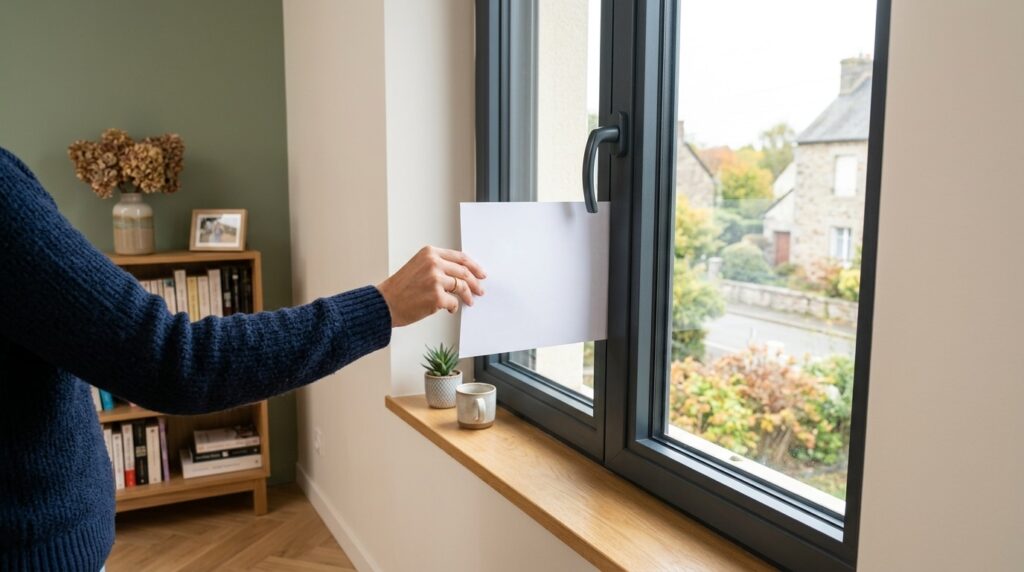
- Insert a piece of paper in the closed window and pull it: if it slides out easily, the seal is letting air in.
- It’s primarily cold air from outside that invades your space, rather than heat escaping from inside.
- A foam adhesive seal (costing between $5 to $10) or a silicone seal (ranging from $10 to $20) can effectively solve the issue at a low cost.
- The paper test: your at-home detective
- Why this draft reveals your windows in September
- Simple solutions to block the cold before winter
The paper test: your at-home detective
The principle is disarmingly simple. Take a standard piece of paper, wedge it between the window sash and the frame, and close it as you normally would. Next, gently pull on the paper. If it resists and requires a little force to slide out, that’s a good sign: your weather seal is doing its job. However, if the paper slips out without any resistance, as if gliding over glass, that’s where the problem lies. Repeat the test at various points on the frame, top, bottom, and sides, because a window can be sealed well in one area and completely compromised elsewhere.
Why this draft reveals your windows in September
Here’s the revelation that clarifies this test: if the paper slides easily, it indicates that cold air from outside is seeping in through the window seal. Contrary to popular belief, it is not the warmth from your home that escapes first through such gaps; rather, it is the cold that invades your space. During this time of year, when nights cool down noticeably more than days, these micro-leaks become particularly apparent. You might notice them without identifying the source: a chill near the windows, a radiator running full blast without adequately warming the room, or that persistent draft sensation even when everything appears closed. Rubber or foam seals age over time, compress, crack, and lose their ability to block the exchange of air between the inside and outside.
Simple solutions to block the cold before winter
The good news is that addressing this issue doesn’t require a large budget or advanced DIY skills. Here’s a look at accessible solutions for everyone.
| Solution | Approximate cost | Effectiveness |
|---|---|---|
| Foam adhesive seal | $5 to $10 | Good, needs annual replacement |
| Silicone or rubber seal | $10 to $20 | Very good, lasts several years |
| Draft stopper | $8 to $15 | Fair, good supplementary solution |
| Thermal lined curtains | $20 to $50 | Complementary, offers visual and thermal comfort |
Replacing a worn-out seal is often the most cost-effective action: a small investment can significantly reduce heat loss. Additionally, check the condition of your window locks, as poorly adjusted locking mechanisms can prevent the sash from sealing tightly against the frame. A simple adjustment can sometimes restore satisfactory sealing without spending a dime.
This straightforward paper test, as rudimentary as it may seem, provides significant insight into the true state of your insulation. Before the cold settles in for the long haul, taking a few minutes to inspect each window in your home can make a real difference in your comfort and heating bills. Why not take the opportunity to conduct a thorough check of your home before the first chill hits?