
Do you enjoy our content?
Stepping into the bathroom after a steaming shower can be a moment of dismay: foggy mirrors, peeling paint in the corners, and that musty smell lingering even with the window open. Your instinct might be to rush out and buy an electric dehumidifier, just like everyone else. However, there’s a simple, eco-friendly trick that has been tucked away in our grandmothers’ secret cupboards for generations, and it won’t break the bank.
- Natural charcoal, placed in a perforated container, absorbs moisture from the air silently and without electricity for less than 10 euros.
- It should be replaced approximately every two months, and silica gel can complement its action in drawers or cabinets.
- The ideal humidity level is between 30 and 50%, and a mechanical ventilation system (VMC) remains the most sustainable long-term solution.
- The electric dehumidifier: a misleading idea that inflates your bill
- Charcoal: the under-10-euro trick that captures moisture
- Instructions and maintenance for healthy air year-round
The electric dehumidifier: a misleading idea that inflates your bill
As autumn settles in and showers become increasingly warm, humidity in the bathroom turns into a real headache. The reflex is often to reach for an electric dehumidifier. The catch? These devices run constantly, emit a loud hum, and, most importantly, significantly increase your electricity bill. Not to mention, they require regular maintenance and can break down at the most inconvenient times. In short, while they may tick the efficiency box, they can leave a bitter taste when it comes to your wallet and environmental impact.
Charcoal: the under-10-euro trick that captures moisture
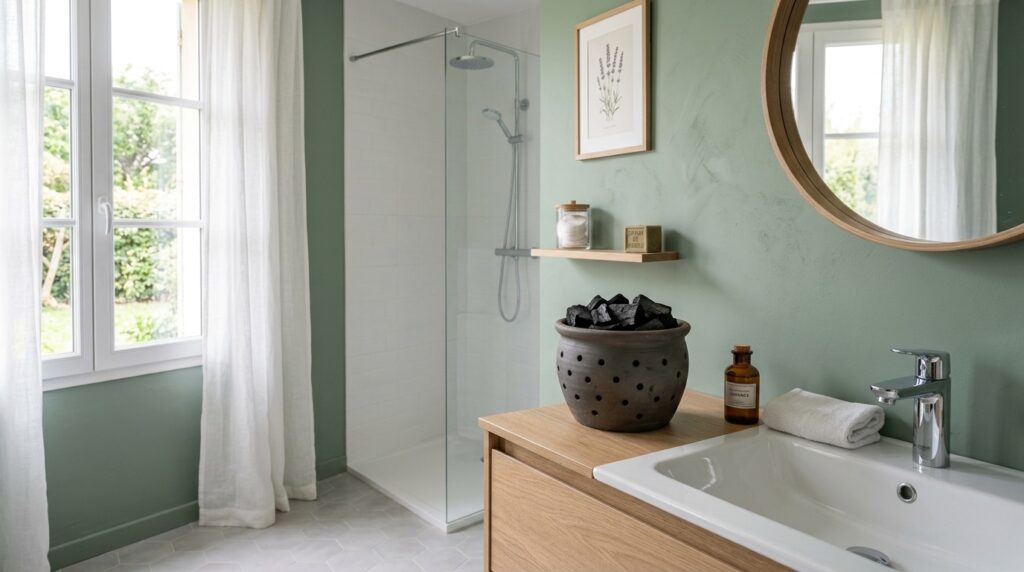
What if the solution lay in a simple punctured tin can? Enter charcoal, a natural material long celebrated for its absorbent properties. When placed in a hermetic container with small holes, it acts like a sponge for moisture, thanks to the porous structure of carbon. Set in a corner of the bathroom, particularly in windowless spaces, it quietly captures water particles suspended in the air without noise, electricity, and for a budget that seldom exceeds 10 euros. While it may not provide the comfort of electric appliances, its effectiveness is undeniable, making it a thoughtful choice for the planet.
Instructions and maintenance for healthy air year-round
To ensure this trick works effectively, a few simple rules must be followed. Opt for natural untreated charcoal, the same type used for barbecuing or water filtration. Once installed in its perforated container, it begins to absorb ambient humidity, but keep in mind: it gradually saturates. It is advisable to replace it approximately every two months, or as soon as it appears damp. Additionally, silica gel—those little packets retrieved from packaging—can be tucked into a drawer or cabinet to absorb any localized excess moisture. To gauge whether your method is working, remember that an ideal humidity level sits between 30 and 50%. If you seek a more long-term solution, installing a VMC is still the gold standard for effectively expelling humid air from wet spaces.
| Solution | Cost | Maintenance | Consumption |
|---|---|---|---|
| Electric dehumidifier | 50 to 200 € | Regular, frequent emptying | High |
| Charcoal | Less than 10 € | Replace every two months | None |
| Silica gel | Free recovery | Change when saturated | None |
| VMC | Initial investment | Low, occasional | Low |
Ultimately, between the noise of an electric dehumidifier and the quiet effectiveness of a simple charcoal pot, the choice becomes clear for anyone looking to save money without sacrificing comfort. This under-10-euro tip reveals that it’s not always necessary to rely on multiple electric devices to maintain a healthy home environment. So, would you consider swapping your dehumidifier for this solution rooted in common sense?






