
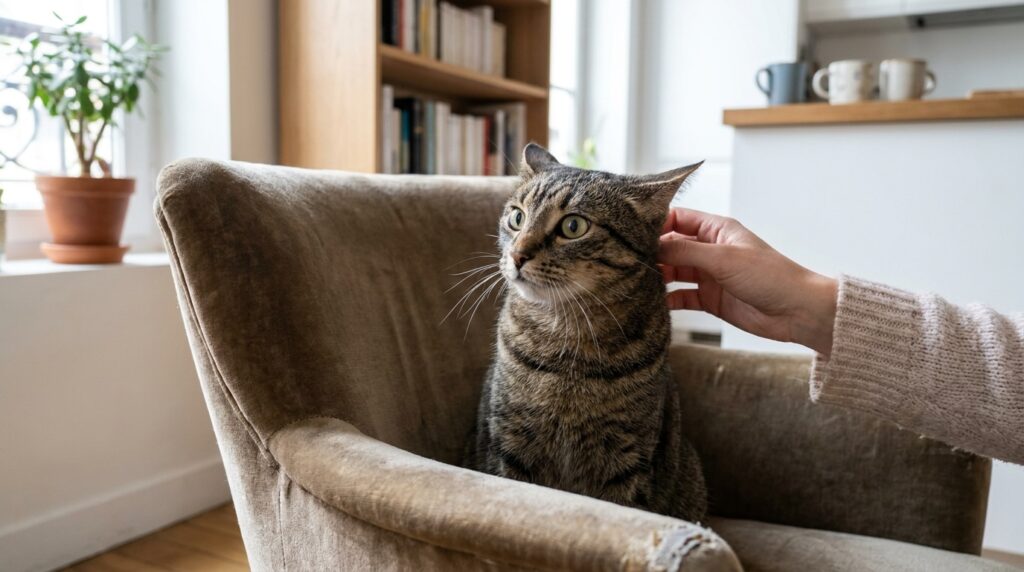
Anthropomorphism continues to be a prevailing misconception among pet owners. During the lively summer months filled with gatherings and festivities, many believe that their affectionate cuddles, overly reassuring words, and bustling lifestyles help alleviate their cats’ loneliness. In reality, these well-meaning gestures often act as ticking time bombs for the animal’s nervous system. It’s time to dispel certain human-centric reflexes: what comforts a human can terrify a feline, often in complete silence. Let’s explore these daily missteps that, under the guise of love, subtly undermine your companion’s mental health.
Stay updated with our latest publications:

The illusion of a happy home: how noise and uninvited guests disrupt their sense of security
As vacation season approaches, prolonged gatherings and slamming doors become commonplace. For a human mind, a lively and music-filled home signifies happiness. For a cat, it translates to a constant auditory alert in an suddenly hostile territory. Cats are hyper-sensitive creatures that map their environment with surgical precision. Any unexpected visitors, loud music, or joyful shouting in the garden disrupt this essential spatial and auditory routine.
Instead of coaxing your cat into this so-called joyful atmosphere by dragging them from their hiding spot, it’s crucial to understand that such disturbances foster a draining state of vigilance. Feline anxiety rarely manifests as audible complaints; it more commonly presents as a frozen posture, compulsive licking, or retreating under furniture. Assuming that exposing your timid cat to the center of the living room will cure their shyness reflects a profound misunderstanding of their fundamental biology.
The trap of overbearing affection: how unwanted touch and punishments erode trust instead of educating
When faced with a cat that shows withdrawal or fear, the typical human response often borders on absurdity: grabbing the animal to shower it with kisses or forcing it onto their lap. Unsolicited petting is not a sign of love; it’s a stifling physical constraint for a creature that has a visceral need for gentle interactions and control over its social encounters. Forcing affection almost instantaneously amplifies their stress.
The situation worsens when this invisible anxiety leads to behavioral issues. If distress drives a cat to urinate outside its litter box or scratch the door frames, the human response often involves yelling or punishment. Reprimanding is an educational aberration. Yelling or spraying water only reinforces the cat’s perception that its territory is dangerous and that humans are inherently unstable. The cat never connects its instinctive stress relief actions to an imagined wrongdoing. Misplaced authority only serves to obliterate the hard-won trust.
The secret to feline happiness by 2026: creating a predictable sanctuary that diffuses anxiety
In contrast to the tendency to treat pets as plush toys that absorb our anxieties, the true solution lies in a more pragmatic approach. In 2026, the overarching trend for ensuring feline well-being focuses on strictly respecting the animal’s ethological sphere. The key to effectively diffusing deep-seated fears is to create a peaceful sanctuary, free from our anthropomorphic excesses.
To mitigate the insidious anxiety caused by noise, unpredictability, and constraint, here are the real daily adjustments that demonstrate your affection:
- Create inaccessible refuge areas, preferably elevated, where no one will intrude or touch them.
- Maintain an unwavering routine for feeding and cleaning their living environment.
- Honor the principle of consent: wait for your cat to seek contact and immediately stop petting at the first subtle sign of irritation (like flattened ears or a swishing tail).
- Avoid unnecessary loud voices and any attempts to discipline or educate through fear.
By ensuring this unyielding routine, eliminating unwanted physical intrusion, and providing untouched retreat areas away from the vacation chaos, you finally stop projecting your own vulnerabilities onto them. This is the essence of true well-being: providing an environment that is deeply aligned with their nature.
Reflecting on the adjustments needed for your companion’s comfort undoubtedly requires setting aside your own ego. Rather than forcing the sensitive and discreet nature of a cat with disproportionate displays of affection, true love paradoxically involves stepping back. As the excitement of summer unfolds, will you be ready to ease the pressure and offer the silent security they so desperately need?






