
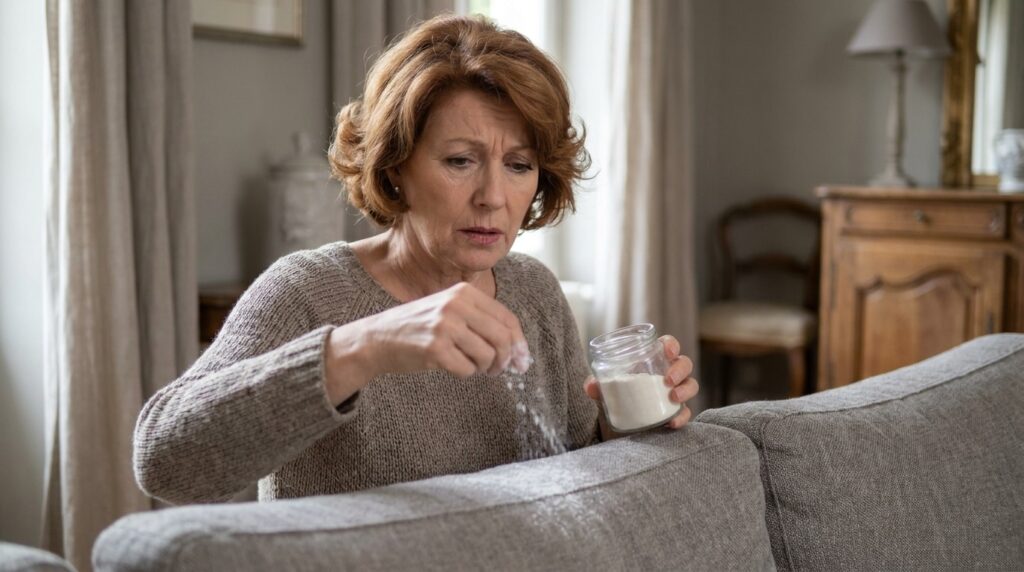
Baking soda on the couch is a go-to trick for maintaining a fresh home: a light dusting, a few minutes of waiting, and one expects to be greeted with a clean-smelling living room. Yet, the results can sometimes be underwhelming: odors return, fabrics appear lackluster, and white residues catch the light, leading to the feeling that “it just doesn’t work.” In truth, baking soda is effective, but only if three details are adhered to: the application method, the quantity, and most importantly, the final step that many overlook. The good news is that it doesn’t require purchasing additional products or scrubbing vigorously. It simply involves adopting the right approach at the right time for a genuine result.
Baking soda, yes… but not just any way: the promise and the pitfalls
Baking soda is favored for its ability to act as a deodorizer and absorb some of the moisture trapped in fabric fibers. When applied to a couch, it helps mitigate lingering scents from cooking, pets, cigarettes, or simply that “lived-in” smell that can develop. Where many go wrong is by treating it like a “magic powder” applied hastily: too thick a layer, neglected areas, or applying it to slightly damp fabric after spot cleaning. The result is that the baking soda clumps, gets embedded, and leaves residues. Another common mistake is rubbing the powder to “help it penetrate.” On certain fabrics, this friction can push particles into the weave, potentially creating light spots, especially if the couch has invisible micro-stains. To ensure the promise of “freshness” holds, the goal is simple: sprinkle a fine mist of powder evenly on a dry fabric and allow the product to work without interference.
The right dosage and timing for a clean couch: a simple rule that makes a difference
To avoid disappointment, the secret lies in two variables: dosage and time to sit. Too little, and the effect is timid. Too much, and the powder becomes difficult to remove and may whiten the fabric’s contours. The practical rule to remember is: 1 tablespoon per seat, lightly sprinkled like a veil. The aim isn’t to “whiten” the couch but to create a uniform presence. The sitting time should be sufficient to capture odors: 30 minutes is generally ideal for refreshing without allowing the baking soda to become so damp that it sticks to the fibers. For a clean application, it’s best to work in sections: seat, then backrest, and armrests. If unsure about the color or material, a discreet test on the back or a seam minimizes risk. And above all, resist the urge to spray water or a fragrance on top: this moistens the fabric, sometimes fixing odors and complicating the next step.
- 1 tablespoon of baking soda per seat (and half a tablespoon for an armrest)
- 30 minutes of sitting time, couch undisturbed
- A light and even sprinkle on perfectly dry fabric
The step everyone forgets: thorough vacuuming (without scrubbing) for true freshness
This is the crucial step that makes all the difference and explains most “it doesn’t work” claims: complete vacuuming. Many quickly remove the powder or vacuum too hastily, using a brush that scratches, leaving behind invisible residues that dull the fabric and can create white spots over time due to friction. The correct approach is to vacuum slowly, crossing over areas, while paying extra attention to seams and junctions. Ideally, a soft brush or upholstery attachment will do the job without damaging the material. Key point: do not rub the baking soda into the fabric when removing it, and avoid “sweeping” by hand, as this will push the powder into the weave. A careful vacuuming creates an immediate sense of “lighter air” in the living room, and the couch regains a fresher feel. If white marks appear despite everything, it’s often a residue: a second, more methodical vacuum usually suffices to eliminate them without needing additional products.
In summary, baking soda delivers on its promises when three habits align: a light sprinkle, 1 tablespoon per seat, and 30 minutes of sitting on perfectly dry fabric. However, efficacy largely hinges on the finale: a meticulous vacuuming, without scrubbing, to remove all powder and avoid marks. So, the next time an odor lingers or your couch loses its freshness, a simple question can guide your actions: has the vacuum really done a thorough job, or just a quick pass?






