
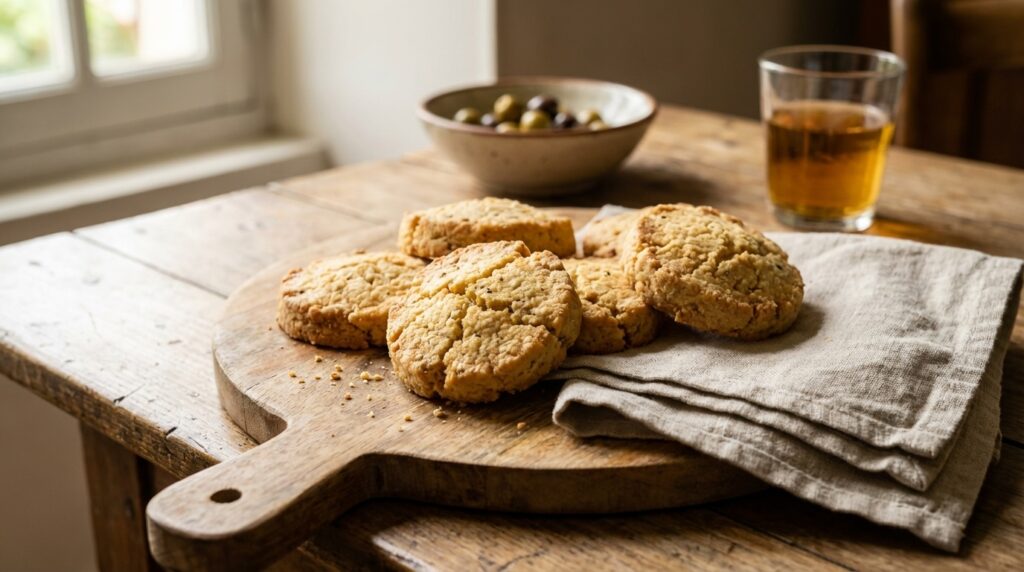
As the days lengthen and springtime aperitifs become a regular affair, it only takes a simple platter on the table to set the mood. Clinking glasses, a few olives, some fresh veggies… and at the center, these parmesan cookies that crumble delightfully at your touch. Their warm, cheesy aroma wafts through the air before the first bite, infused with an intriguing hint of herbs. These are the kind of savory biscuits you nibble on without thinking, only to find yourself casting glances at the bowl, casually seeking another piece. They crunch, they melt, and they leave a hint of character on your palate. Suddenly, the aperitif shifts: conversations continue, but your hand instinctively reaches back for more.
The ingredients
- 120 g all-purpose flour
- 100 g cold unsalted butter, diced
- 80 g finely grated parmesan
- 1 medium egg
- 1 teaspoon dried oregano
- 2 pinches black pepper
- 1 pinch salt (optional, depending on the parmesan)
The steps
Preheat the oven to 180 °C (350 °F) and line a baking sheet with parchment paper. Remove the butter just before use to keep it cold.
In a mixing bowl, combine the flour, parmesan, oregano, and pepper. Add the butter and work it in with your fingertips until the mixture resembles coarse sand. Avoid smoothing the dough, as this contributes to the crunchiness.
Add the egg and mix quickly until the dough comes together. Form a ball, flatten it into a disk, and refrigerate for 20 minutes for cleaner cuts and uniform cookies.
Roll out the dough to a thickness of 5 to 7 mm (about 1/4 inch) and cut out desired shapes. Place them on the baking sheet with slight spacing: the dough won’t spread much, but they brown better with air circulation. Aim for uniform thickness for even cooking.
Bake for 12 minutes, until the edges are lightly golden. Keep an eye on them: there’s only a minute between perfect and overdone. Look for a light golden color and the fragrant aroma of toasted parmesan.
Allow them to cool on the baking sheet for 5 minutes before transferring to a wire rack. This cooling process finalizes the texture, ensuring a satisfying crunch while keeping a hint of softness inside.
The aperitif takes a turn: the unexpected twist that makes these parmesan cookies irresistible
These cookies play on a simple duo: a buttery base that crumbles and a cheese that lingers on the palate. The result is a dry, crumbly sensation at first, followed by a round and salty finish, exactly the kind of contrast that keeps you coming back for more.
The surprising detail is the oregano, which adds a Mediterranean note and a nearly toasted impression reminiscent of a perfectly baked focaccia. No one expects it to be in a parmesan cookie, yet it changes everything.
To maintain balance, the parmesan should flavor without overwhelming. Too much cheese, and the cookies become overly salty and aggressive. Not enough butter, and the texture becomes too dry. Here, the proportions allow for a satisfying bite and an aromatic finish.
The ingredients: the heart of the recipe and what sets it apart
The list remains short, which is precisely what makes it unbeatable: butter, flour, parmesan, egg, oregano. Each element is noticeable, so every choice counts. The butter provides crunch, while the parmesan gives character.
An interesting parmesan is an aged cheese, with nutty aromas and balanced salinity. A cheese that is too young primarily contributes salt without depth. Look for a fruity scent and a fine grate to ensure the cheese blends seamlessly into the dough.
Without straying from the recipe, a few additions can stay true to the aperitif spirit: a twist of a mill for a bolder pepper flavor, a hint of chili for discreet warmth, or seeds for added crunch. The goal is to maintain a parmesan-dominant profile with a clear herbal note.
The steps: a routine that guarantees neat and golden cookies
With the oven set to 180 °C (350 °F) and the baking sheet ready, everything flows smoothly. A shortbread dough appreciates speed: the less it warms in your hands, the crunchier and better-shaped the cookies will be.
The key action is to rub the ingredients together with your fingers, then bind with the egg without extensive kneading. Over-kneading results in harder cookies. A barely assembled dough promises a crumbly texture and a delicately melting center.
When shaping, thickness is crucial. Too thin, and they break and dry out. Too thick, and they remain pale. The edges will be neat if the dough is fresh and if the cookie cutter is pressed firmly. Aim for uniform and well-shaped cookies.
Cooking time is 12 minutes: enough to brown, not enough to dry out. The color on the edges is the best indicator, not the center. Once out of the oven, the cooling process finalizes the work: it promises a clean crunch and a lingering flavor.
The secret that makes them “addictive”: texture, flavor, and small variations
To balance crunch and melt-in-your-mouth softness, the simplest variable is thickness: 5 mm for a drier, crispier cookie, 7 mm for a softer one. The dough must remain cold; otherwise, the butter melts too early, and the texture loses its magic.
To enhance the oregano without overpowering it, simply rub it briefly between your palms before adding it. This releases its fragrance and allows it to diffuse better. The result is a more expressive note, yet still well-balanced with the parmesan.
Regarding aperitif variations, oregano welcomes its cousins: thyme, herbes de Provence, or very finely chopped rosemary. Parmesan can also blend with a touch of pecorino or a hint of comté. The idea is to keep a buttery base and a cheesy signature.
Serving like a pro: pairing ideas and tips to avoid mistakes
On an aperitif table, these cookies love contrasts: a lemony yogurt dip, a tapenade, or a roasted pepper cream. They also pair wonderfully with olives and fine charcuterie. Look for a creamy and tangy salty duo to awaken the parmesan.
For drinks, a dry and crisp white, refreshing bubbles, or a not-too-sweet blonde beer make a natural pairing. The oregano calls for something vibrant, and the parmesan enjoys a thirst-quenching beverage that cleanses the palate.






