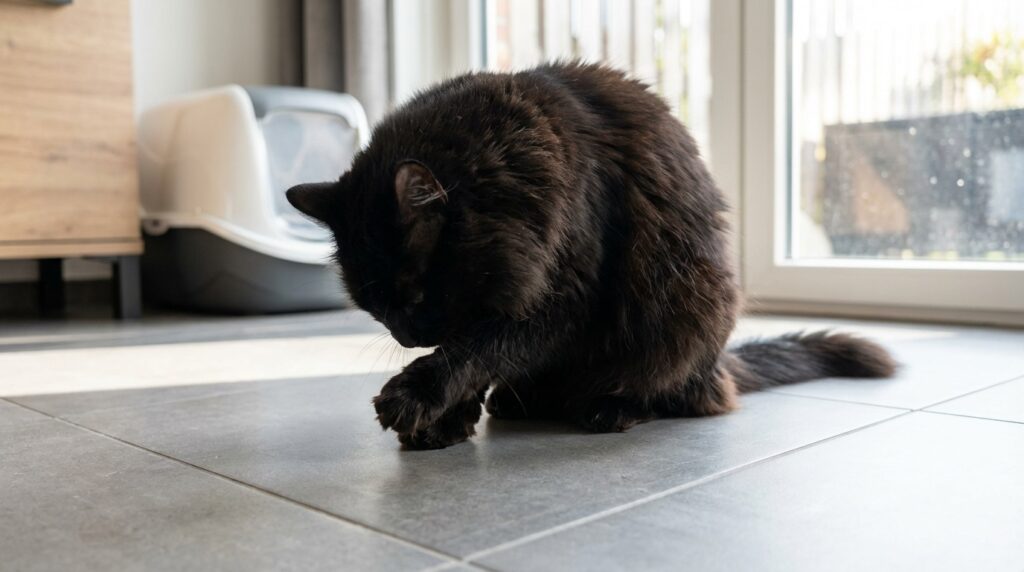
Every day, you watch your cat with a mix of amusement and confusion as it frantically scratches the floor around its litter box, looking intensely focused.
You might have thought it was diligently wiping its paws to keep your home pristine, especially during your spring cleaning? Think again!
Behind this amusing, sliding choreography, reminiscent of an ice skater, lie fascinating instincts and, at times, valuable insights into its overall health.
Discover what your feline is really trying to communicate as it diligently works on the floor.
A Personal Scent Message Secretly Left on Your Floor
The Often Overlooked Role of Pheromones Between Your Cat’s Toes
Some owners still naively believe that cats are cleanliness enthusiasts, intent on sparing the living room rugs.
The clinical reality is quite different and often unknown to the general public.
Cats possess specialized structures located between their paw pads, known as digital glands.
By scratching the ground repeatedly, they release pheromones that are imperceptible to humans but incredibly communicative to other felines.
This creates a chemical signature that is imprinted on the laundry room floor.
The Wild Territorial Instinct That Replaces Your Idea of Hygienic Cleaning
A cat remains a finely-tuned predator, even when basking comfortably in the sun, lulled by the gentle warmth of spring.
After using the litter box, it obeys a deep, ancestral instinct.
This vigorous scratching and post-litter patting serve as both visual and olfactory marking.
The animal traces invisible lines to define its territory and unmistakably signal that this elimination zone is exclusively its own.
The notion of a cat carefully wiping its paws is thus pure anthropomorphism.
The Exact Moment This Little Dance Should Raise Your Suspicions
The Subtle Line Between Natural Elimination Ritual and Manifest Discomfort
While this olfactory marking behavior through digital glands and post-litter scratching is entirely normal in most cases, it’s essential not to overlook potential warning signs.
A sudden change in behavior or an almost neurotic insistence on scratching the edges of the box may indicate more than just a desire to communicate.
When the joyful habit turns into frantic agitation, accompanied by plaintive meows or avoidance of rough surfaces, a keen observer realizes that something is disturbing the animal.
Invisible Irritations and Pain That Require Close Inspection
The animal’s scratching takes on a different context if it results from persistent irritation or pain.
Especially dusty litter, sharp mineral granules, or residues from harsh household cleaners can easily irritate the delicate skin of feline paws.
Sometimes, tiny wounds or invisible cracks, only noticeable upon close examination, can provoke this compulsive scratching reaction.
The feline attempts to relieve a latent burning sensation or remove a stinging allergen through this misguided gesture.
Take Care of Its Paws to Keep the Joyful Patting Going
Essential Recap to Differentiate Between Olfactory Communication and Physical Discomfort
Distinguishing the healthy expression of a temperament from an underlying skin issue requires some attentive observation.
- If your cat alternates between its front paws, proudly sniffing the perimeter before confidently walking away: no worries, the territory is marked.
- If it suddenly stops to lick its paws frantically after scratching and appears to shake its foot: a lesion is likely present.
- If the paw pads show a cardboard-like texture, diffuse redness, or extreme dryness: a little intervention is warranted.
Best Practices to Ensure Healthy Paws and a Thriving Life
To prevent this natural instinctive behavior from becoming painful, standard hygiene remains the strongest preventive measure.
With the gradual return of warm weather, outdoor strolls increase, and paws endure new environmental stresses.
Make it a habit to check for the presence of foxtails or micro-cuts.
Opt for a gentle, unscented litter, and carefully rinse floors cleaned with harsh chemical products.
Periodic hydration using specific balms helps combat excessive dryness, ensuring optimal movement for the animal.
In conclusion, your cat’s frantic ballet on the tiles is, above all, a masterful method of communication rooted in the genetics of this little apartment predator.
As long as your feline is lively, and its skin remains supple and smooth to the touch, allow it to leave its secret messages and assert its authority over the household.
Have you ever taken the time to inspect the condition of your little feline’s paws to ensure that its famous choreography remains a strictly territorial ritual?